Scope of performance
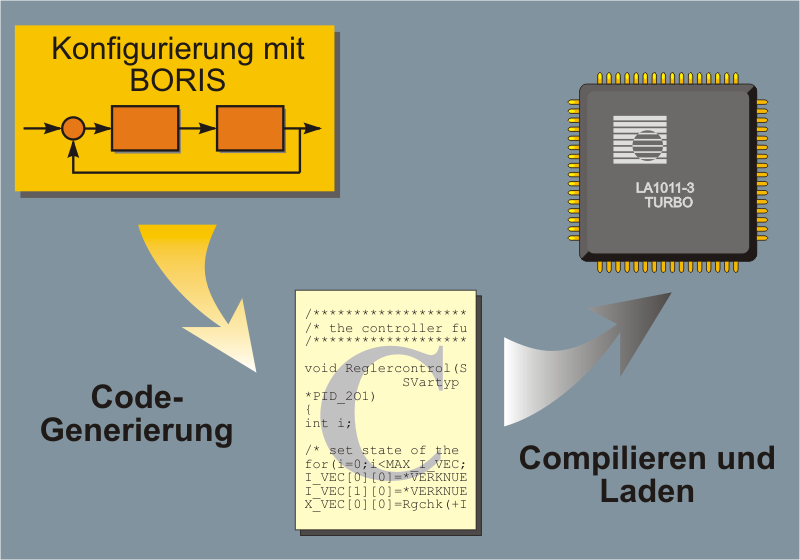
Normally its a great step from the PC-simulation to the perfect product. The BORIS-AutoCode-Generator helps you saving most of this work! At a simple mouse click he generates just out of the comfortable BORIS development environment the corresponding ANSI-C-code for a user defined part of the system structure (e. g. the controller) – and all that for a price you would never have expected! Design and optimize your new products in shortest space of time on a graphical level at your PC instead of programming and debugging hundreds or thousends of source code lines!
Various options enable the code to be optimal adjusted to the target hardware. You decide, how fast and exact your code will be – the AutoCode-generator offers you all the tools you need!
The C-code generation is not restricted to standard blocks of automation and control – nearly all block types of the extensive block library of BORIS (depending on the purchased edition) can be transformed to C-code! As a matter of course this also includes superblocks as well as signal sources and drains or user-written blocks. Therefore not only applications in the fields of automation and control can be handled: Problems of data aquisition are solved with the same simplicity as the realization of digital circuits and filters or the “programming” of the target hardware as a flexible signal generator. Even complex open loop systems may be designed in this way with minimum effort. The complexity of the structure transformed to C-code in principle is not restricted.
All numerical algorithms used within the C-code exactly correspond to the algorithms used within the BORIS development environment. Thus the user can be sure to get identical system behavior later on the target hardware. The possibility to write specific signals into SIM-files out of the C-code enables a direct comparison of these signals with their originals.
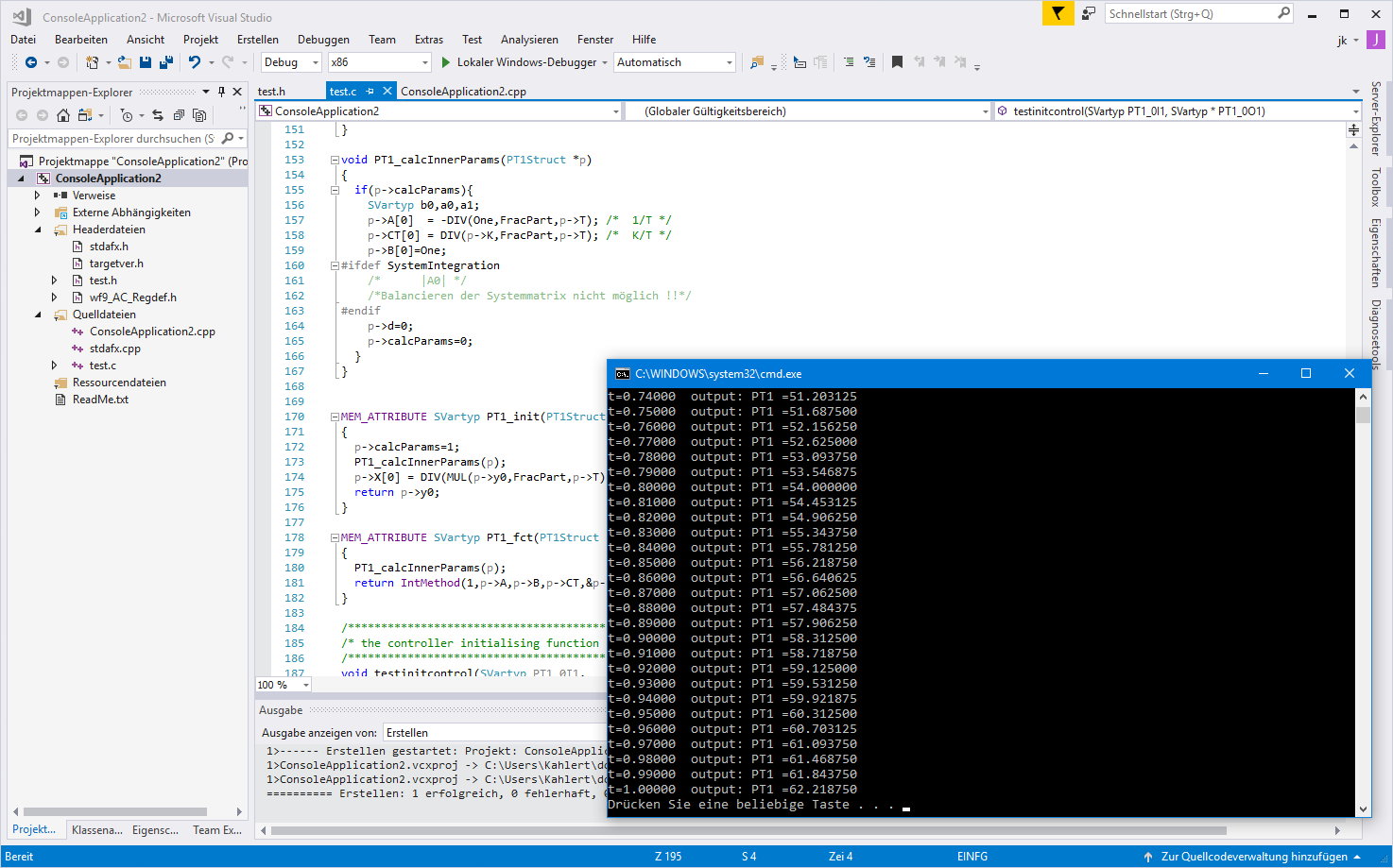
Generated C-Code in the Microsoft Visual Studio
Three steps to heaven
Under assistance of the BORIS-AutoCode-generator the production cycle is limited to no more than three steps:
- Configuration and test of the system structure on block diagram level with BORIS
- Generation of C-code with the AutoCode-generator
- Compilation of the C-code and transfer to the target hardware
Flexibility
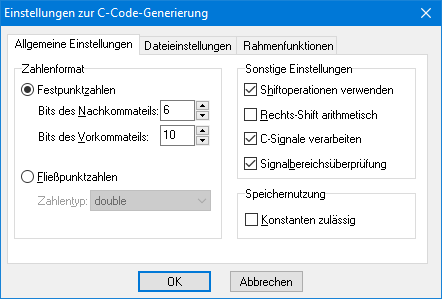
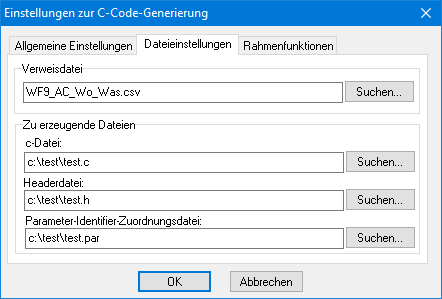
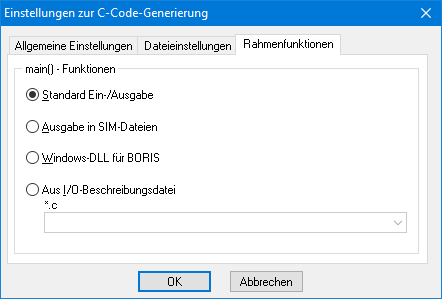
Caused by its flexibility the generated code can be adjusted to any kind of target hardware. The bit resolution of all block parameters and signals can be choosen independently. 8-, 16- and 32-bit resolution are available with a user-defined splitting between exactness and value range. By the comfortable integration of hardware specific I/O-functions as special block types (C-code input resp. output) the same code can easily be adapted to varying target hardware (see screenshots below).
Debugging functions
For debugging purposes various main-functions are at disposal. These e. g. enable the input of test values via the keyboards or the file-output of specific signals in BORIS-SIM-files. Another feature is the automatical generation of a BORIS-User-DLL which can later be integrated into a simulation. In this way very complex simulations (e. g. numerical optimizazions) can be accelerated rapidly.
Open architecture
The generated C-code is extensively documented and can be interpreted by the user easily. Therefore the user-executed modification of the sources – e. g. for the integration of alternative algorithms – is no problem. In the same way the realization of hardware specific output functions – e. g. digital or analogue displays – can be carried out.
Target platforms
The BORIS-AutoCode-generator offers various platforms for his application:
- The code may be integrated in user-specific PC-based software. Doing this the user saves a lot of time for writing his own block and integration algorithms, programming the simulation loop, and, and, and…
- By transferring the compiled code to standard microcontroller modules these can be used as flexible open or closed loop controllers or – e. g. for education or training – as plant simulators.
- The compiled code can be used as a DOS-TSR-program in connection with a PC-card. Thus also very dynamic data aquisition or control problems which require a very small sampling time can be realized in real-time. The AutoCode-generator includes interfaces for most standard card types.
Videos
 |
Generierung von ANSI-C-Code aus BORIS (German) |
Documentations and product information
 |
Product information “WinFACT-AutoCode-Generator” (German) |
Prices
BORIS-AutoCode-Generator Professional Edition
| Single user licence Industry: | EUR | 750,00 |
| Education licence: | EUR | 750,00 |
Please refer to our price lists for current prices of all products!